
DocumentationExtend Gadgets
Gadgets and the four rings
Bring the personal agent into the physical world through a stable capability contract.
A gadget gives Impo a physical interface: a display, microphone, speaker, camera, button, sensor or actuator. ESP32 firmware and the Linux Device SDK connect to the gateway, register what they can do and receive commands for their paired account.
The hardware SDK lives in impo-gadget-sdk. The API, worker and gateway live in impo. A board port belongs in the SDK; account policy belongs in the application platform.
The four rings#
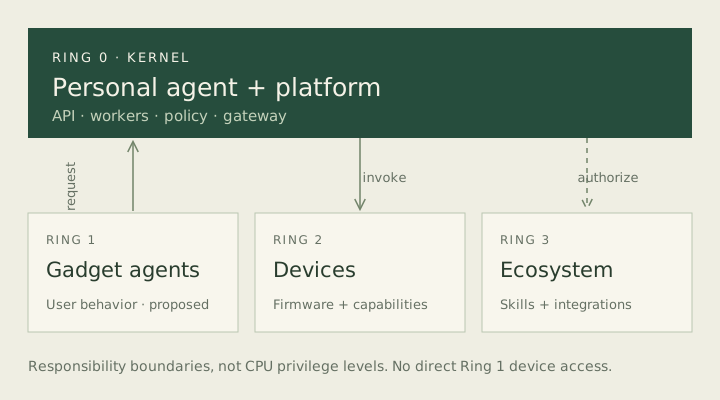
| Ring | Responsibility | Extension owner |
|---|---|---|
| 0 — Kernel | Personal agent, API, worker, dispatcher and gateway. Identity, permissions, routing and execution policy. | Platform maintainers. |
| 1 — Gadget agents | Persistent user behavior: triggers, allowed actions, instructions and state. Proposed. | Users with their personal agent, through validated creation tools. |
| 2 — Devices | Firmware, board adapters and exported commands, capabilities and events. | Makers and SDK maintainers. |
| 3 — Ecosystem | Product-specific skills and integrations for other devices. Impo's home-network tunnel is not implemented. | Integration authors. |
These are responsibility boundaries, not CPU protection levels. The four numbered layers are Impo's adaptation of the kernel/user-space idea discussed in the Dreamer interview, especially 21:55–23:23. They are not a claim about Dreamer's hardware architecture.
One rule for authority#
Ring 1 asks Ring 0 to act. It does not receive device administration credentials or bypass account policy. The same applies to a Ring 3 integration: a skill can explain an operation, but cannot grant permission to perform it.
Kernel mediation means server-enforced policy. It does not require a fresh main-chat model turn for every fixed action. The planned rules runtime can execute a validated action without calling a model.
What exists today#
Gadgets pair to an account, register commands_v2 and a capability summary, and exchange link.invoke, link.result and link.event messages. Main Chat discovers registered commands through impo_list_gadgets and calls impo_gadget_command.
Events currently enter main Chat as [Gadget event] messages. The gateway sends the resulting spoken reply back to the originating gadget. A separate subscription router and user-created gadget-agent definitions do not exist yet.
Pick your path#
- Have hardware to support? Start with add a board or Linux device.
- Need a new operation or sensor event? Read commands and events.
- Want reusable, user-created behavior? Read the gadget-agent design.
- Connecting another product? Check ecosystem integrations and the current transport limits.
The complete Gadgets design record includes policy requirements, implementation gaps and delivery stages. The SDK's capability vocabulary owns command names, parameters and results.